
Here we will explore what is and where is the Schönbrunn Gloriette, an architectural gem that forms part of the majestic Schönbrunn Palace. Find out how to visit it and which areas are free and which require payment.
Support when you need it
Customer service to help you with all your needs from 8:00 a.m. to 7:00 p.m.
Fast and online booking
Choose the best option for your needs and preferences and avoid the lines.
Top attraction in Vienna
Discover Vienna’s most famous palace and step into centuries of imperial history.
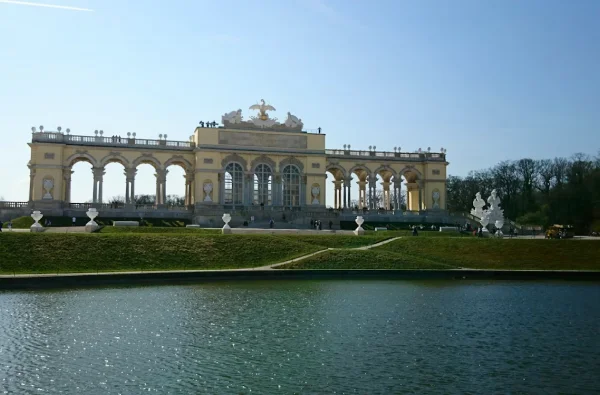
The Schönbrunn Gloriette is the largest and most significant commemorative monument within the gardens of Schönbrunn Palace. Situated atop a hill, it dominates the grounds and offers one of the most stunning panoramic views of Vienna and the palace. In fact, if you look closely, you will understand that it is strategically located to be the architectural culmination of the Baroque visual axis that originates at the palace.
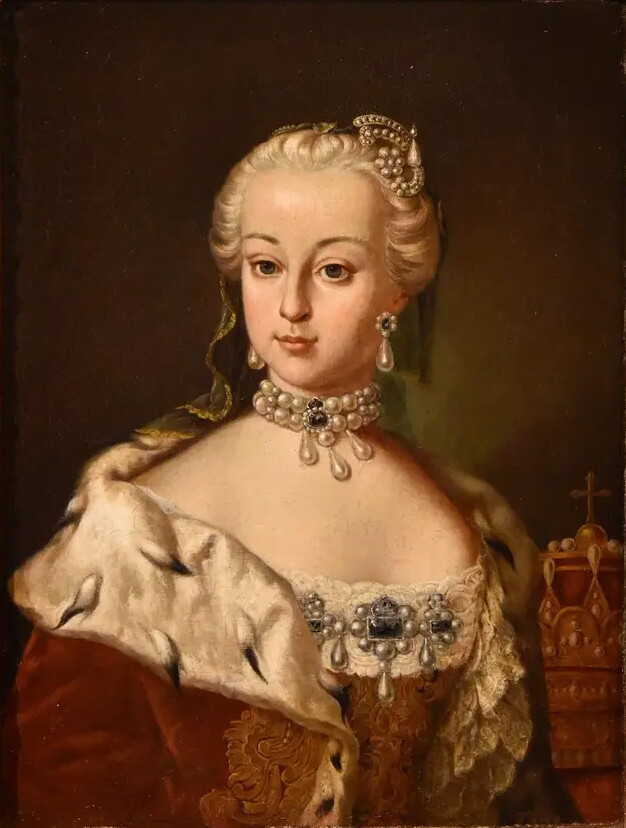
The history of the Schönbrunn Gloriette begins in 1775 with the decision by Empress Maria Theresa I of Austria to erect a “temple of fame” at the highest point of the palace gardens. It was built as the last major structure in the garden, under the direction of the architect Johann Ferdinand Hetzendorf von Hohenberg. Its main purpose went beyond being an attraction and a lookout point; its official dedication establishes it as a solemn monument to the “just war that led to peace,” referencing the major 18th-century conflicts, such as the War of the Austrian Succession and the Seven Years’ War.
To realize this triumphant vision, the architect employed an ingenious historical and economic measure: the reuse of materials. Empress Maria Theresa I herself ordered that an old gallery of pillars and cornices be extracted and transported to Schönbrunn from the Neugebäude Palace (a large complex of Mannerist-style castles located in Simmering, a district of Vienna, built in 1569 by order of Emperor Maximilian II of the House of Habsburg).
This hard, white imperial stone, along with bull heads and other components, was used in the construction of the Gloriette, lending it a sense of historical continuity and monumentality. Despite being severely damaged during World War II, it was restored on two occasions (1947 and 1995), recovering its historic glazing and maintaining its function as a lookout point with panoramic views of Vienna.
The structure itself is magnificent: a central section shaped like a triumphal arch, flanked by wings with elegant semicircular arches. At the top rests a powerful statue of an imperial eagle on a golden globe. Inside, during the imperial era (between 1790 and 1910), the three central arches were glazed so that royalty could enjoy the space. It is even known that Emperor Franz Joseph and Sisi, his wife, used a room located here for breakfast.
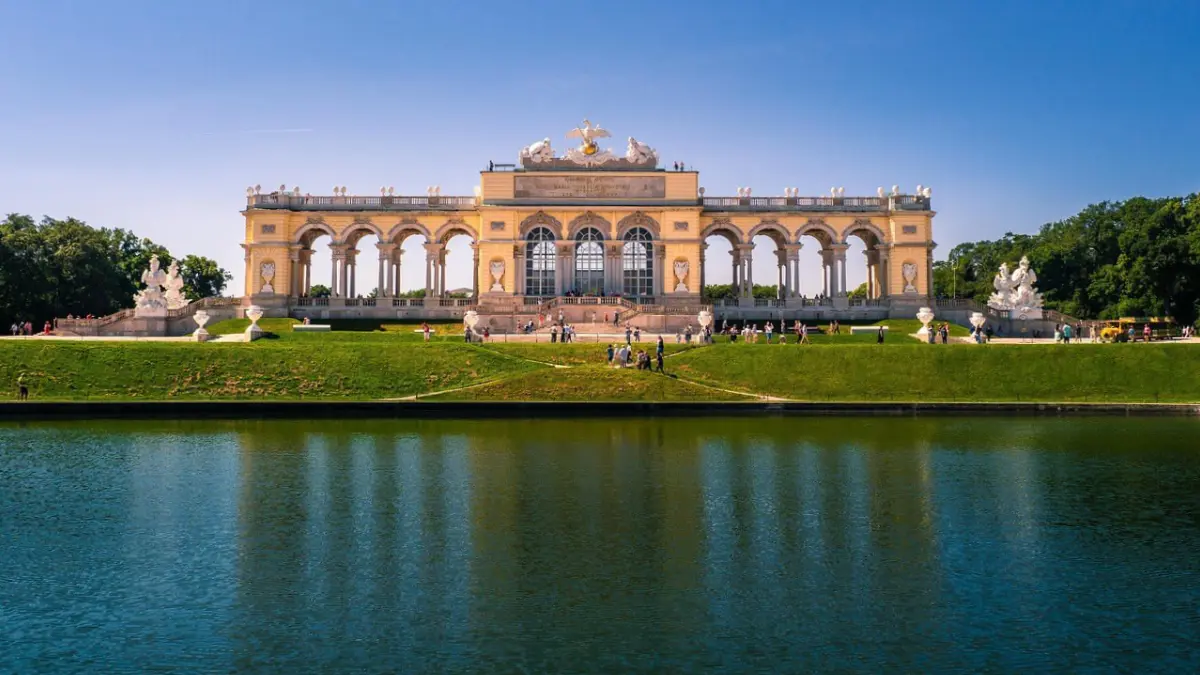
Since its construction, the Gloriette has served both as a panoramic viewpoint over Vienna and the gardens and as a space for court gatherings and relaxation. Over the centuries, it has been the setting for banquets, imperial meetings, and, later, a popular spot for visitors and tourists. After minor damage during World War II, it was carefully restored and today is one of the most emblematic elements of the Schönbrunn complex, maintaining its original functions intact: offering a majestic view of the palace, reinforcing the harmony of the Baroque landscape design, and housing the Café Gloriette.
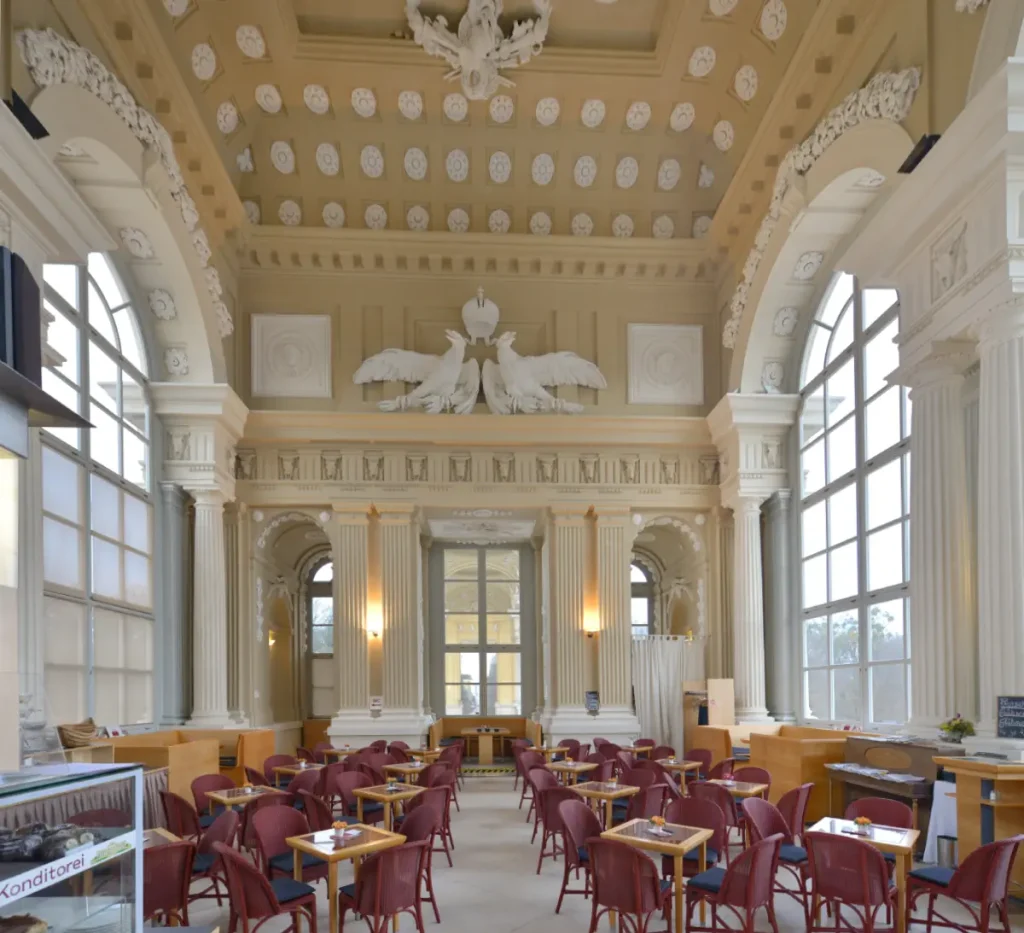
An interesting fact you will like to know is that, today, the famous Café Gloriette is located in the same central room where the Emperor and his wife used to have breakfast. You can enter, sit down, and enjoy a coffee or a brunch (famous for those served with live piano and violin on weekends) in a place with over 200 years of imperial history. Café Gloriette allows you to emulate the imperial couple, enjoying a traditional Viennese pastry while looking out over the palace and the city skyline. It truly is a unique experience, don’t you think?
“Is the Schönbrunn Gloriette free?” This is one of the most important questions for organizing your visit to Vienna.
Access to the Schönbrunn Palace Park and Gardens is free for the public. The gardens open every day of the year from 6:30 AM. This includes the Gloriette itself; that is, you can climb the hill and admire this beautiful building for free. Visiting the famous Café Gloriette on the ground floor is also free, you only pay, logically, for what you consume inside.
However, there are certain areas within the extensive park and, more specifically, in the Gloriette itself, that do require an access ticket. The most notable is the Observation Terrace or rooftop of the Gloriette. If you want to go up to the top for the most spectacular view of Vienna, you will need to purchase a ticket.
Despite the main park access being free, there are certain attractions we recommend visiting. These are the free and paid areas you should consider during your visit to the majestic Schönbrunn Palace:
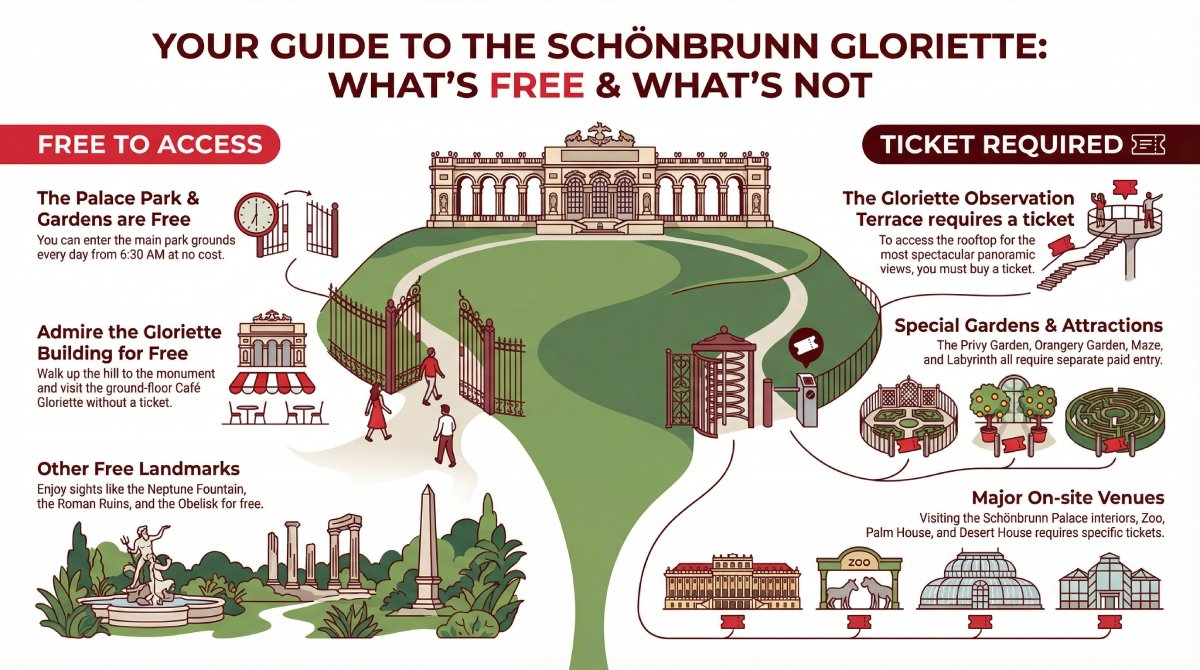
The areas you can enjoy without spending a euro are:
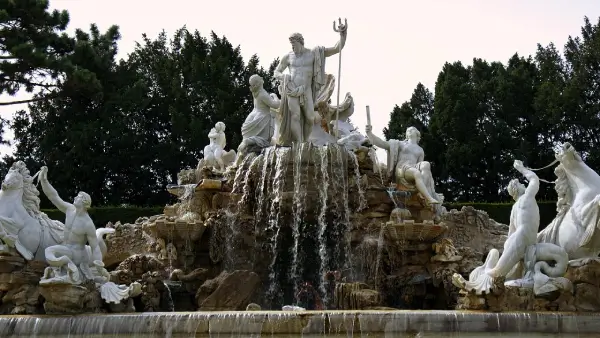
If you want to delve deeper into the park and its attractions, here are the ones that require a specific entrance ticket:
Keep in mind that these paid areas, including the Gloriette terrace, usually have seasonal opening hours, so we recommend checking the opening and closing times for each one to ensure your visit.
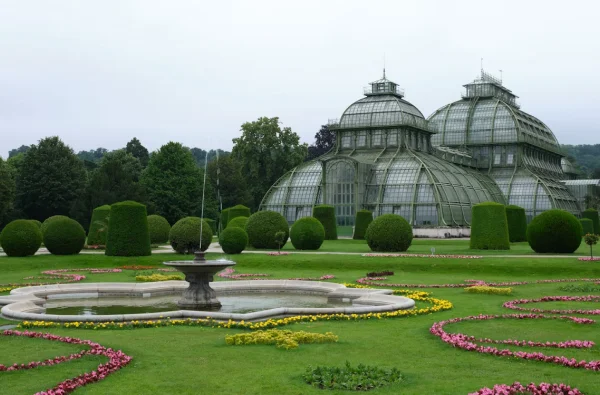
The truth is that the best way to visit the park is to start with the Schönbrunn Palace (provided you have bought a ticket to see its interior) and then embark on the walk to the Gloriette.
However, if you only want to visit the park and the Gloriette, our recommendation is as follows:
To get to the Gloriette, you must first reach the Schönbrunn Palace, which is easy to get to, as it is very well connected with Vienna’s public transport system.
The fastest way is to use the subway (U-Bahn). You need to take the U4 line and get off at the Schönbrunn station. From there, the main entrance of the palace is just a 5-7 minute walk.
If you prefer to use the tram, another ideal option for seeing the city while you travel, you can use lines 10 or 60 and get off directly at the Schloss Schönbrunn stop. Alternatively, the 10A bus is also available.
Once you arrive at the main entrance of Schönbrunn Palace, you will have to walk across the Grand Parterre, the vast formal garden, towards the back of the palace. The Gloriette is located right at the end, at the top of the hill. You have to climb that gentle slope, which will take you about 15 to 20 minutes, depending on your pace. The walk is truly part of the experience, as it allows you to appreciate the monumental scale of the Baroque garden.
If you have mobility issues or simply prefer to avoid tiring yourself out for the rest of the day, you might consider taking the Schönbrunn Panoramic Train, which travels through the gardens and has a stop at the Gloriette. However, this train requires a fee and has its own timetable and route.
In summary, our recommendation is to use the subway or tram to the palace. That way, you only have to prepare for a pleasant (and necessary) uphill walk through the gardens to reach the Gloriette and enjoy the breathtaking views.
If you are wondering if the Gloriette is worth visiting, the answer is a resounding yes. This area is an essential part of the Schönbrunn experience. It is the vantage point that unifies the palace’s majesty with the sheer size of the Austrian capital. Moreover, we must not forget that it is one of the most iconic landmarks in Vienna.
The simple walk through the free gardens to the top of the hill is already rewarding, as it allows you to appreciate the symmetrical design and the grand Baroque axis envisioned by Maria Theresa. As you traverse these green spaces, you not only gain a different perspective of Schönbrunn Palace and its gardens but also connect with the history and symbolism of the monarchy of the time.
To top it all off, it is a place you can visit regardless of your budget, as there is a free option (which allows you to visit the base of the Gloriette and enjoy the views by having a picnic or passing through the Roman Ruins) and a minimum-fee option (which will offer you the possibility of climbing the Gloriette terrace for a small investment, ideal if you enjoy photography or simply want the best panorama).
While other paid areas, such as the Labyrinth or the Crown Prince’s Garden, offer entertainment and floral beauty, the Gloriette offers the most iconic perspective and the deepest historical significance outside the palace rooms. So yes, the view, the history, and the architecture make every step of the climb to the hill worthwhile.
The view from the upper terrace of the Gloriette is, quite simply, the best panorama you will get of Schönbrunn Palace and one of the most beautiful in all of Vienna. One of the most common questions at this point is, “Can you see the whole city?” and yes, practically all of it, in a way that allows you to understand part of the geography and history of the Austrian capital.
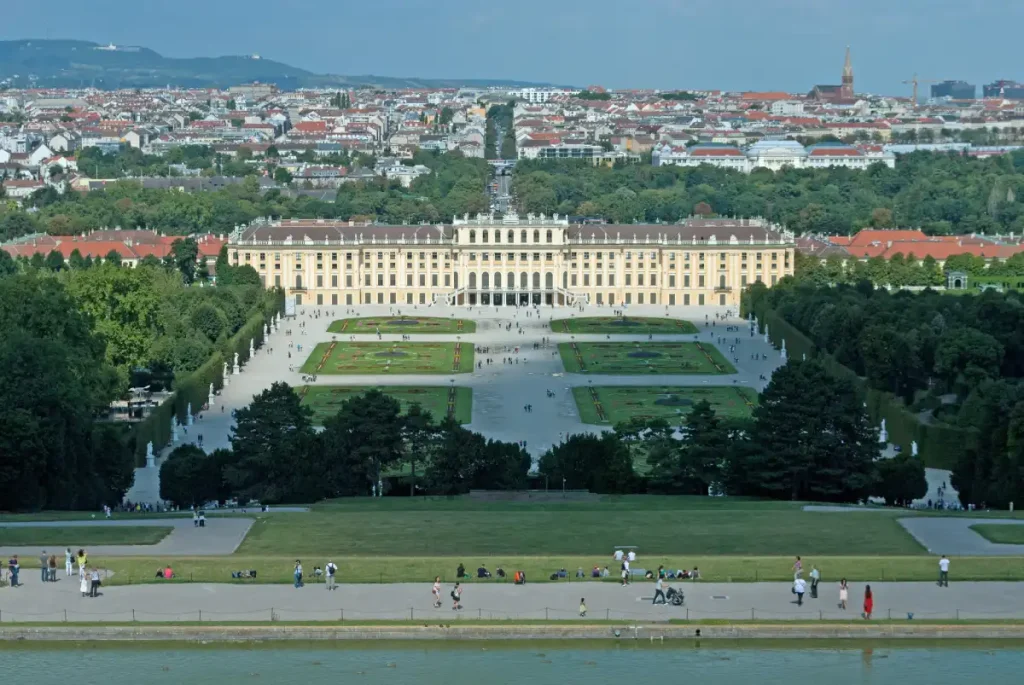
Just below you, in the foreground, you will see Schönbrunn Palace, looking much larger than it appears from the entrance courtyard. From this position, you can appreciate the symmetry of the gardens and the Neptune Fountain.
Looking towards the city, you will see the Vienna skyline and can easily distinguish the most emblematic buildings: such as the unmistakable spire of St. Stephen’s Cathedral (Stephansdom), the rooftops and towers of the historic centre, Belvedere Palace in the distance, and even the Ferris Wheel in the Prater if the day is very clear. As you can see, the Gloriette is positioned in such a way that it frames the palace with the city in the background, creating a perfect souvenir postcard.
On the opposite side, you will see the vast Vienna Woods (Wienerwald), a green mass that offers a tranquil contrast to the imperial splendour of the palace. It is a view that allows you to appreciate the urban planning, the green immensity of the parks, and, above all, the majesty that the Habsburg monarchy sought to project. Without a doubt, it is the ideal way to etch the image of Vienna into your memory.


