
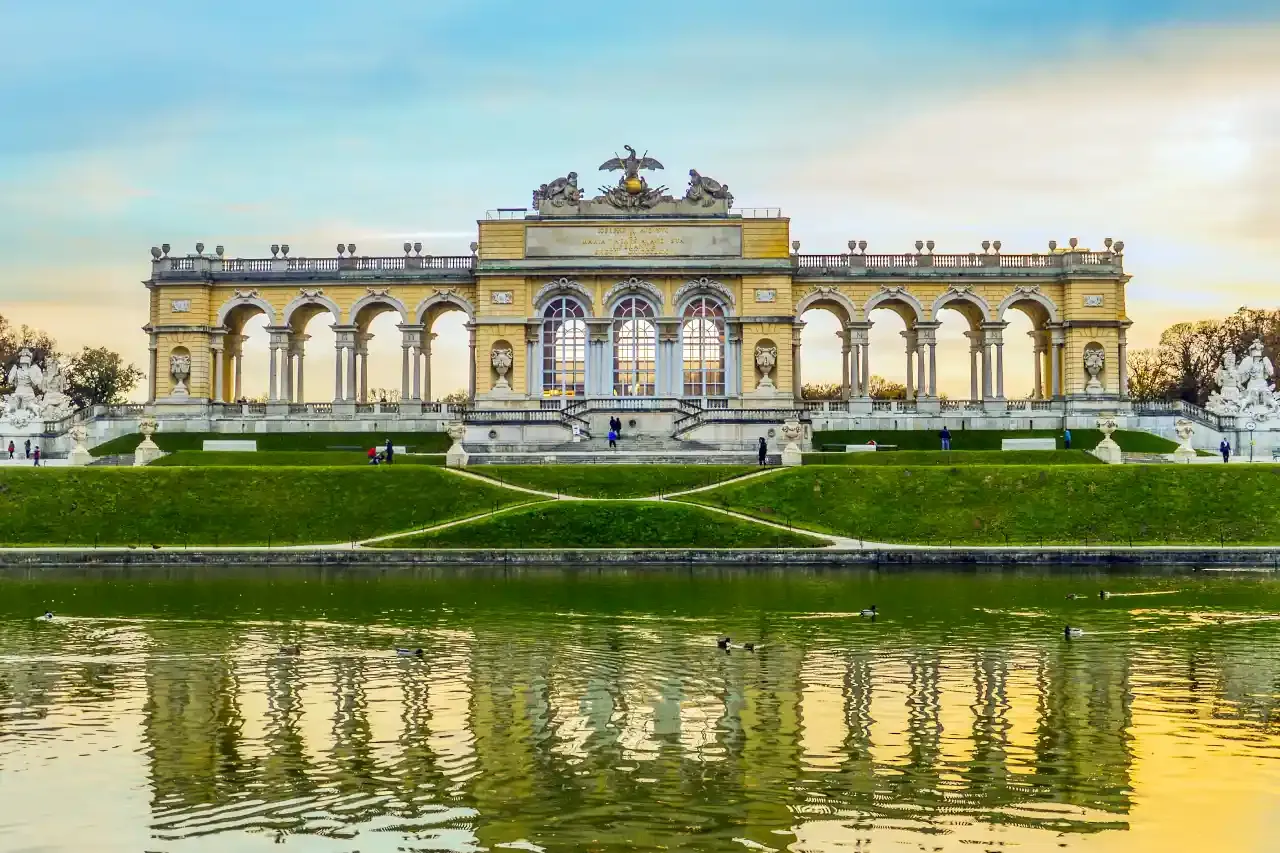
Schönbrunn Gloriette
Here we will explore what is and where is the Schönbrunn Gloriette, an architectural gem that forms part of the majestic Schönbrunn Palace. Find out how to visit it and which areas are free and which require payment
What is the Schönbrunn Gloriette?
The Schönbrunn Gloriette is the largest and most significant commemorative monument within the gardens of Schönbrunn Palace. Situated atop a hill, it dominates the grounds and offers one of the most stunning panoramic views of Vienna and the palace. In fact, if you look closely, you will understand that it is strategically located to be the architectural culmination of the Baroque visual axis that originates at the palace.
History of the Schönbrunn Gloriette
The history of the Schönbrunn Gloriette begins in 1775 with the decision by Empress Maria Theresa I of Austria to erect a “temple of fame” at the highest point of the palace gardens. It was built as the last major structure in the garden, under the direction of the architect Johann Ferdinand Hetzendorf von Hohenberg.
Its main purpose went beyond being an attraction and a lookout point; its official dedication establishes it as a solemn monument to the “just war that led to peace,” referencing the major 18th-century conflicts, such as the War of the Austrian Succession and the Seven Years’ War.
Architecture of the Gloriette
The architect employed an ingenious historical and economic measure: the reuse of materials. Empress Maria Theresa I herself ordered that an old gallery of pillars and cornices be extracted and transported to Schönbrunn from the Neugebäude Palace (a large complex of Mannerist-style castles located in Simmering, a district of Vienna, built in 1569 by order of Emperor Maximilian II of the House of Habsburg).
This hard, white imperial stone, along with bull heads and other components, was used in the construction of the Gloriette, lending it a sense of historical continuity and monumentality. Despite being severely damaged during World War II, it was restored on two occasions (1947 and 1995), recovering its historic glazing and maintaining its function as a lookout point with panoramic views of Vienna.
The structure itself is magnificent: a central section shaped like a triumphal arch, flanked by wings with elegant semicircular arches. At the top rests a powerful statue of an imperial eagle on a golden globe. Inside, during the imperial era (between 1790 and 1910), the three central arches were glazed so that royalty could enjoy the space. It is even known that Emperor Franz Joseph and Sisi, his wife, used a room located here for breakfast.
The Café Gloriette
Since its construction, the Gloriette has served as a panoramic viewpoint and a majestic space for imperial gatherings. Though damaged during World War II, careful restoration preserved its role as a focal point of the Baroque landscape. Today, it houses the Café Gloriette in the very room where the Emperor and his wife once enjoyed breakfast.
Visitors can emulate the imperial couple by savoring traditional Viennese pastries or a weekend brunch accompanied by live piano and violin music. Offering over 200 years of history, the café provides a unique opportunity to relax while overlooking the palace and the city skyline. It remains an emblematic destination where imperial tradition meets modern leisure in a truly stunning setting.
Is a ticket required to access the Gloriette?
“Is the Schönbrunn Gloriette free?” This is one of the most important questions for organizing your visit to Vienna.
Access to the Schönbrunn Palace Park and Gardens is free for the public. The gardens open every day of the year from 6:30 AM. This includes the Gloriette itself; that is, you can climb the hill and admire this beautiful building for free. Visiting the famous Café Gloriette on the ground floor is also free, you only pay, logically, for what you consume inside.
However, there are certain areas within the extensive park and, more specifically, in the Gloriette itself, that do require an access ticket. The most notable is the Observation Terrace or rooftop of the Gloriette. If you want to go up to the top for the most spectacular view of Vienna, you will need to purchase a ticket.
Despite the main park access being free, there are certain attractions we recommend visiting. These are the free and paid areas you should consider during your visit to the majestic Schönbrunn Palace:
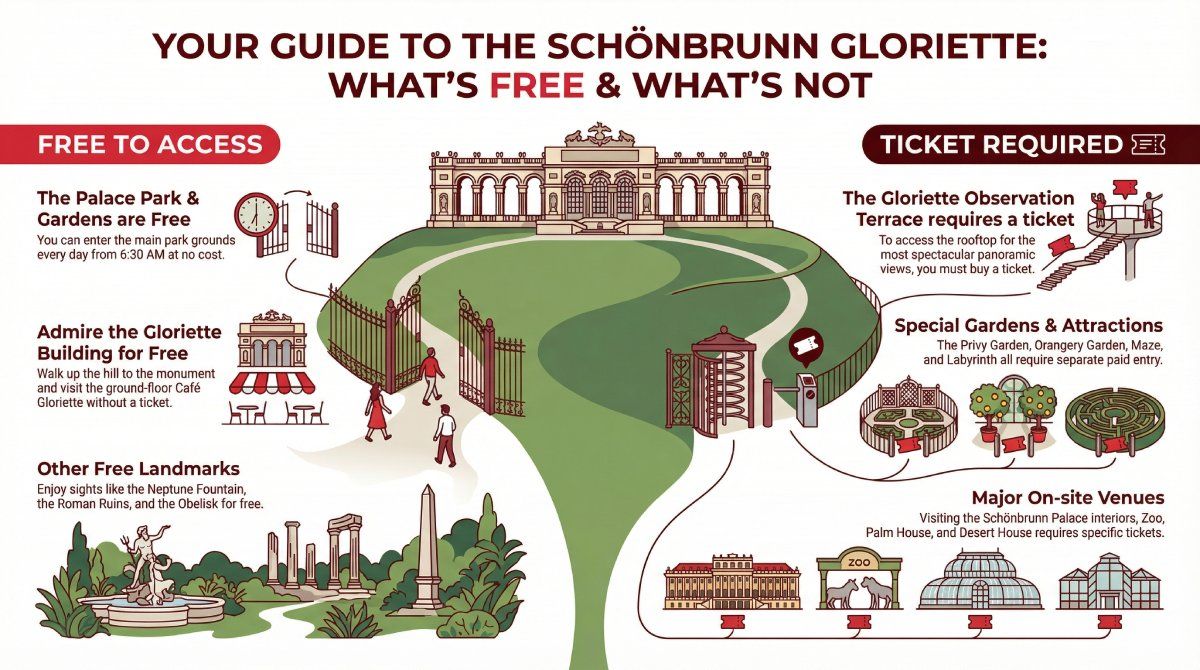
Free areas of the park
The areas you can enjoy without spending a euro are:
- The Grand Parterre: The vast expanse of lawn and flowers in front of the palace, ideal for strolling.
- The Neptune Fountain: One of the most impressive Baroque fountains on the grounds.
- The Gloriette (ground floor): The building itself, which you can access and admire at no cost, in addition to entering the Café Gloriette (only paying for your consumption).
- The Roman Ruins: An artificial landscaping feature in the form of ruins that was common in gardens of the era.
- The Obelisk and its fountains.
- Most of the paths and tree-lined avenues of the extensive park.
Areas requiring a ticket
If you want to delve deeper into the park and its attractions, here are the ones that require a specific entrance ticket:
- Gloriette Observation Terrace: as mentioned, if you want to climb to the viewpoint and admire the panoramic views over the park and Vienna, you will need to buy a specific ticket.
- Privy Garden or Crown Prince’s Garden (Kronprinzengarten): a private and historic formal garden, with hedges and geometric flowerbeds. Requires a seasonal ticket.
- Maze & Labyrinth (Labyrinth + “Labyrinthikon” children’s area): a recreational area with hedges, paths, an observation platform, and games. It’s ideal for families. A specific ticket is needed for the labyrinth.
- Orangery Garden: a historic garden with citrus trees and exotic plants. The interior or full access requires a ticket. When there are concerts or certain activities inside, a special ticket may be necessary in some cases.
- Desert House (Wüstenhaus Schönbrunn): a botanical house/desert, part of the complex. It also requires a ticket if you want to visit its interior.
- Schönbrunn Palace (interiors): a ticket is required to visit the interiors of the palace (Imperial Tour, Grand Tour, etc.).
- Schönbrunn Zoo: the historic palace zoo, with animals, exhibits, glass houses, and much more. Access is via a specific ticket or a combined ticket.
- Palm House (Palmenhaus Schönbrunn): a greenhouse with a large botanical collection of exotic plants. An entrance ticket is also required to visit it.
Keep in mind that these paid areas, including the Gloriette terrace, usually have seasonal opening hours, so we recommend checking the opening and closing times for each one to ensure your visit.
Best way to visit the park together with the Gloriette
The truth is that the best way to visit the park is to start with the Schönbrunn Palace (provided you have bought a ticket to see its interior) and then embark on the walk to the Gloriette.
However, if you only want to visit the park and the Gloriette, our recommendation is as follows:
- Entry: Enter through the main gate (or any of the side gates) at 6:30 AM. We know, it’s very early, but this way you can ensure a peaceful walk through the green areas and enjoy the natural light at that hour.
- Start walking: Head directly towards the Gloriette hill. It’s a gentle climb, about 800 meters, which will warm you up for the rest of the day.
- Enjoy the free views and have a coffee: The view from the base of the Gloriette is already spectacular. If the Café Gloriette is open at this time, you can take the opportunity to have breakfast there.
- Climb to the paid terrace: If you want to go up to the rooftop, buy your ticket and prepare to enjoy the views. From here, they are even better, as we will detail in the following lines.
- Continue your stroll: Once back down, you can decide whether to buy tickets for the Labyrinth, the Crown Prince’s Garden, the Orangery, or simply enjoy the large free spaces like the Neptune Fountain and the Roman Ruins.
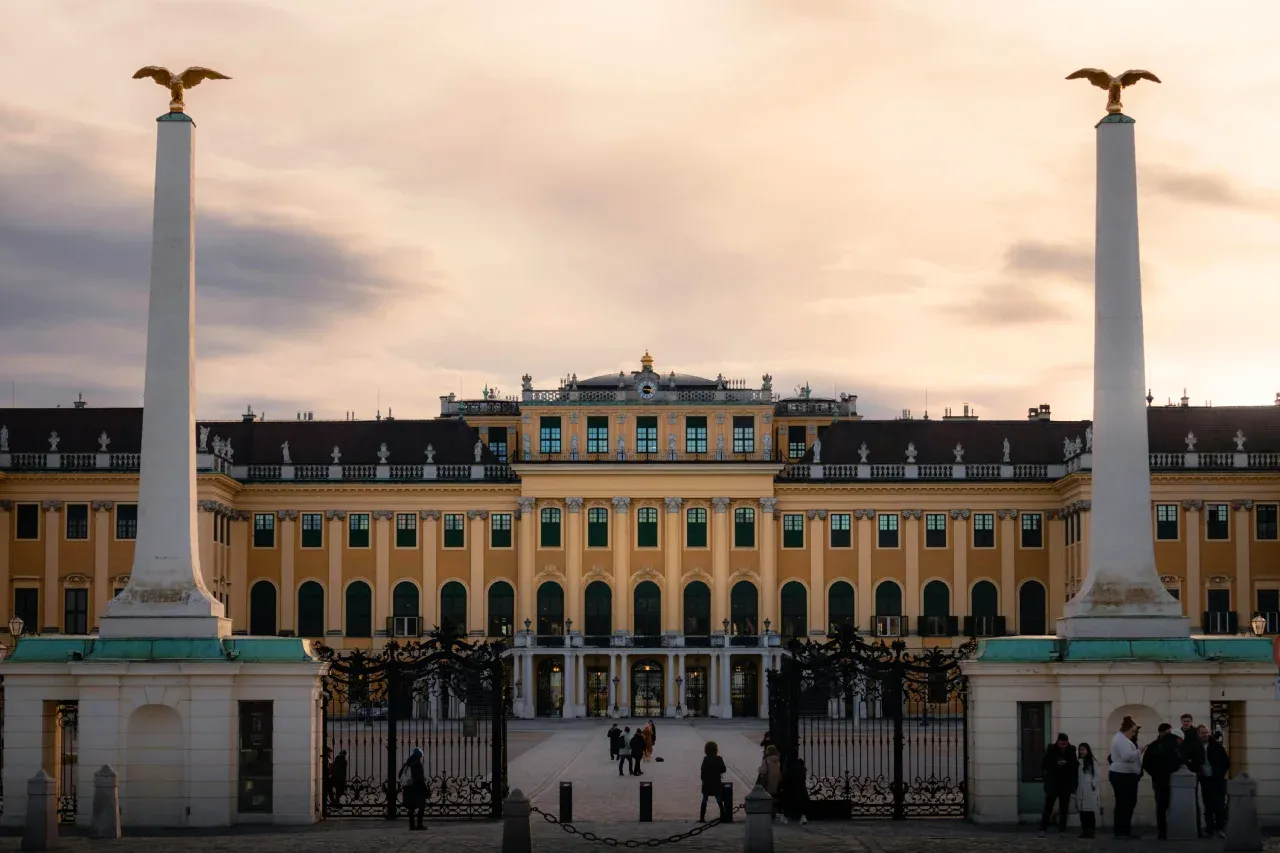
How to get to the Gloriette?
To get to the Gloriette, you must first reach the Schönbrunn Palace, which is easy to get to, as it is very well connected with Vienna’s public transport system.
The fastest route is via the U4 subway line to the Schönbrunn station, followed by a short walk to the palace entrance. Alternatively, trams 10 or 60 and the 10A bus stop directly at Schloss Schönbrunn.
Once inside, cross the Grand Parterre toward the hill. The climb takes approximately 15 to 20 minutes, offering a monumental perspective of the Baroque gardens.
For those with mobility concerns or seeking a more relaxed journey, the Schönbrunn Panoramic Train (paid service) circles the grounds with a dedicated stop at the Gloriette. Whether walking or riding, the journey is an essential part of the imperial experience.
Is the Gloriette worth visiting?
If you are wondering if the Gloriette is worth visiting, the answer is a resounding yes. This area is an essential part of the Schönbrunn experience. It is the vantage point that unifies the palace’s majesty with the sheer size of the Austrian capital. Moreover, we must not forget that it is one of the most iconic landmarks in Vienna.
The simple walk through the free gardens to the top of the hill is already rewarding, as it allows you to appreciate the symmetrical design and the grand Baroque axis envisioned by Maria Theresa. As you traverse these green spaces, you not only gain a different perspective of Schönbrunn Palace and its gardens but also connect with the history and symbolism of the monarchy of the time.
To top it all off, it is a place you can visit regardless of your budget, as there is a free option (which allows you to visit the base of the Gloriette and enjoy the views by having a picnic or passing through the Roman Ruins) and a minimum-fee option (which will offer you the possibility of climbing the Gloriette terrace for a small investment, ideal if you enjoy photography or simply want the best panorama).
While other paid areas, such as the Labyrinth or the Crown Prince’s Garden, offer entertainment and floral beauty, the Gloriette offers the most iconic perspective and the deepest historical significance outside the palace rooms. So yes, the view, the history, and the architecture make every step of the climb to the hill worthwhile.
What can you see from the top of the Gloriette?
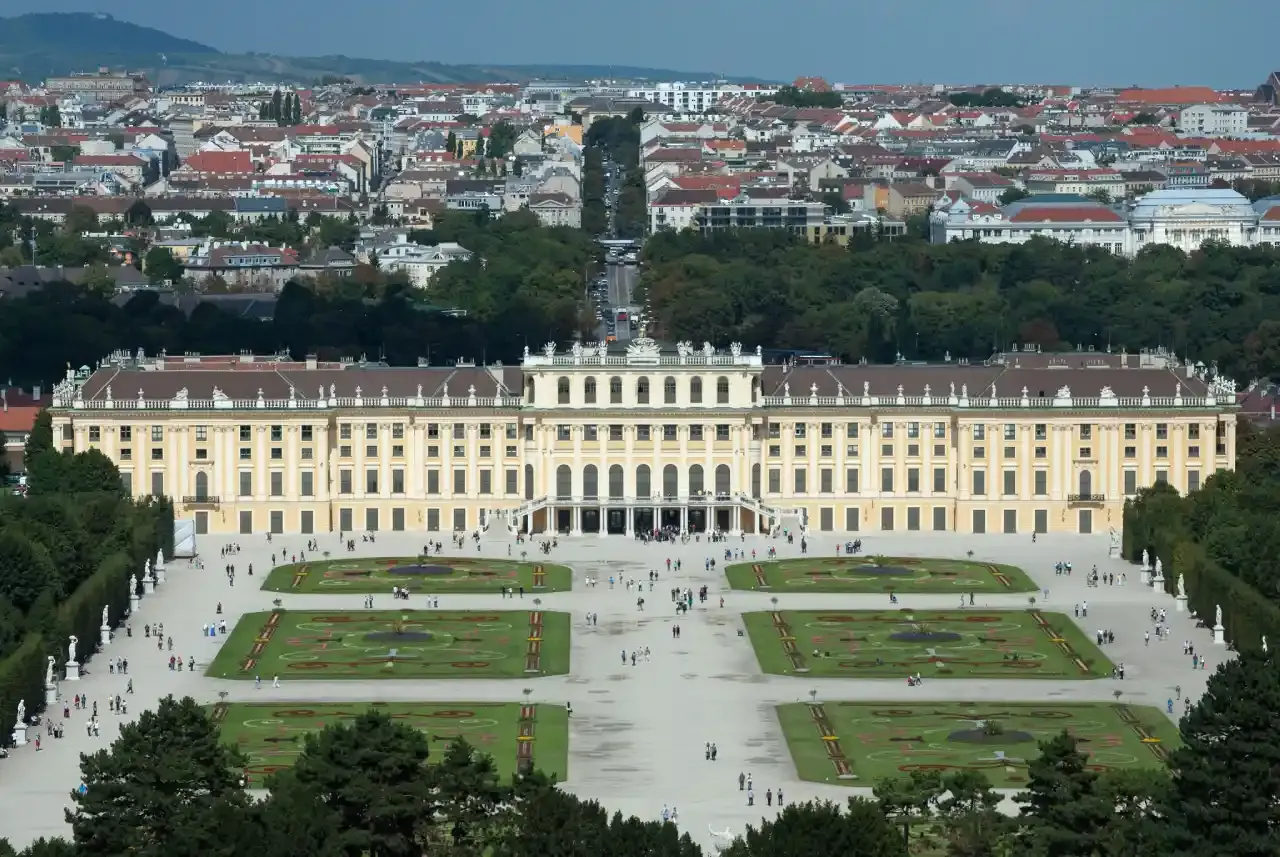
What can you see from the top of the Gloriette?
The upper terrace provides a panoramic view of Schönbrunn Palace and the Vienna skyline. Directly below, the palace reveals its full scale and architectural symmetry, overlooking the geometric patterns of the formal gardens. From this elevation, the central axis of the estate aligns perfectly with the city's streets, extending toward the horizon.
Beyond the palace grounds, the urban landscape of Vienna unfolds, featuring a dense tapestry of historic and modern rooftops. On clear days, landmarks such as St. Stephen’s Cathedral are visible against the skyline. To the sides, the greenery of the park and the distant Vienna Woods frame the scene, illustrating the transition between imperial grounds and the capital city.
Photo: “Panoramic view from the Gloriette. Schönbrunn Palace” by stephengg.